
The shoes are by the door, breakfast is finished, and your child is still holding a shirt instead of putting it on. When school or daycare starts at a fixed time, getting dressed can become the most stressful part of the morning.
For preschoolers and children in the early school years, dressing is both a practical task and an opportunity to participate. Your child might manage one part easily and need help with another. You do not have to turn every weekday into a lesson. Try making the routine easier to follow, then choose one small step to practice.
1. Prepare fewer decisions before morning
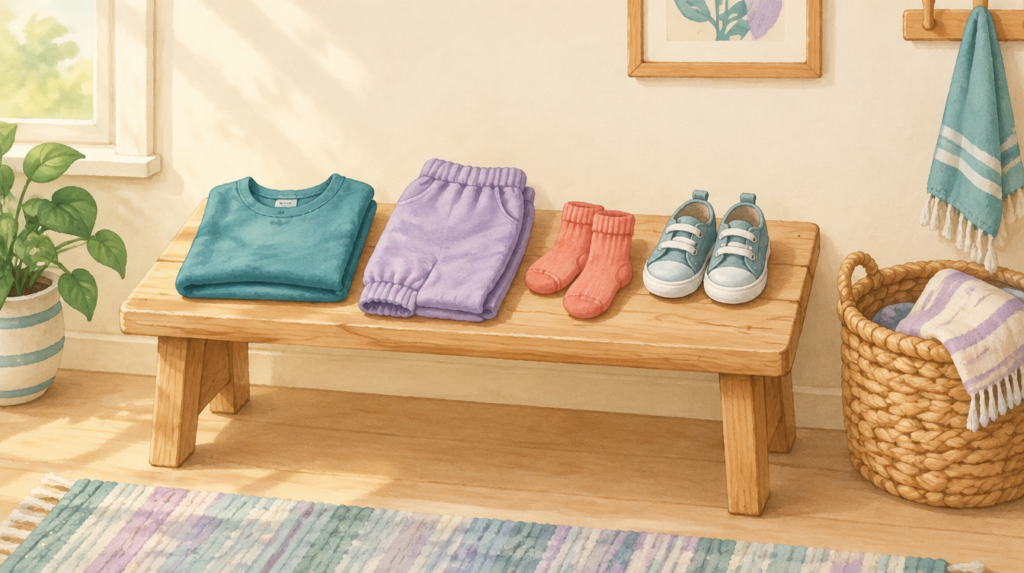
The American Academy of Pediatrics recommends preparing clothing the night before and offering choices within a predictable routine. Together, select two comfortable outfit options, then let your child choose one. Put the clothes where you will actually get dressed, with socks and shoes nearby. Read the AAP’s family routine guidance.
Illustrative example: At bedtime, ask, “The blue shirt or the green shirt tomorrow?” In the morning, the chosen outfit is waiting. This is a practical experiment, not a rule that every family needs to follow. If choosing is overwhelming, start with one familiar outfit.
Notice where the routine gets stuck. Is your child searching for clothes, struggling to start, or asking for help with a fastener? That observation is more useful than deciding the whole morning was a success or failure.
2. Make the next step visible
A short picture sequence can support a child who has trouble remembering what comes next. A children’s occupational therapy resource from Warrington and Halton Teaching Hospitals describes visual reminders and breaking everyday activities into smaller steps. See its visual support examples.
Try three simple drawings or photos: clothes, breakfast, and shoes. Point to the current picture and give one brief instruction. Use your family’s usual order. A homemade paper strip is enough; you do not need a special chart or app.
Illustrative example: After breakfast, point to the shoe picture and say, “Shoes next.” If your child still needs you beside them, stay and help. A picture is a reminder, not a test of independence.
3. Practice one manageable part
The AAP emphasizes that dressing independence develops through practice and guidance. Choose a part your child can work on without taking over the entire routine, such as pulling a shirt down after you help with the sleeves. Offer enough assistance for participation, and acknowledge the specific effort: “You pulled it down yourself.” Read more about supporting young children’s independence.
On a rushed day, it is reasonable to provide more help and practice later. Keep a brief note of the step you tried and the help needed. This gives you something concrete to discuss with your child’s therapist without adding another complicated tracking system.
When to ask for support
If dressing regularly prevents your child from joining school, daycare, or family activities, share the specific difficulty with their pediatrician or occupational therapist. Occupational therapy addresses dressing, caregiver support, and daily routines, as outlined by the American Occupational Therapy Association. A routine suggestion alone cannot explain every child’s difficulty.
Optional tools for trying this at home
Here are a few optional tools for trying these activities at home. You can also use what you already have. If you purchase through these links, Sensory Bridge may receive a small commission at no additional cost to you. As an Amazon Associate I earn from qualifying purchases.
- Crayola Ultra-Clean Washable Broad Line Markers, 10 count on Amazon (ages 3+): Draw the clothing, breakfast and shoe pictures for a simple morning sequence. Supervise use and keep caps away from children who mouth objects.
- Time Timer MOD, 60-minute Education Edition on Amazon: For a child who likes visual cues, an adult can show the time until the next routine. Avoid racing or withholding help when time ends. Keep the device and battery out of young children’s reach.
Use what you have: Photos or pencil drawings on scrap paper work, and a familiar spoken cue may be all your child needs.
If you would like to discuss getting dressed or other everyday skills, call Sensory Bridge Pediatric Therapy at (909) 258-9292.