
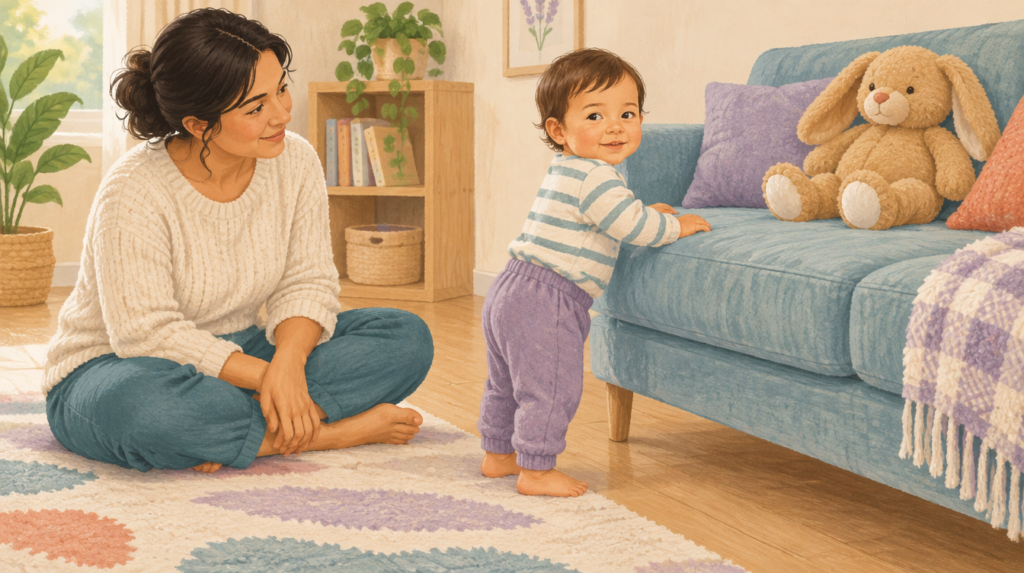
Your baby pulls up at the sofa, moves sideways toward a favorite toy, then drops to the floor and crawls away. You may wonder whether walking is just around the corner, or whether you should be doing more to help.
Standing while holding furniture and moving along it, often called cruising, are part of the path toward independent steps. There is room for everyday play during this stage without turning your living room into a training course. Here are three ways to make those opportunities safe and manageable.
1. Make a small space safe for exploring
Choose a clear, level floor area and stay close. Check that furniture your child uses for support will not slide or tip and has no sharp edges. Secure furniture that needs anchoring, block access to stairs, and remove small objects from the floor. The American Academy of Pediatrics describes these precautions in its guide to early movement.
Illustrative activity: If your child already pulls up and moves along a sturdy sofa, place a familiar large toy a little to the side, within comfortable reach. Stay beside them while they explore. Let them return to sitting or crawling when they choose. Avoid placing the toy across a gap that requires them to let go before they are ready.
This can fit into a short play break while you are together. It does not need a set number of repetitions, a special piece of equipment, or a goal of taking a step that day.
2. Let familiar play lead the movement
Early walking may look different from one moment to the next. A child may try a step and then choose crawling again. The AAP notes that children sometimes crawl even after walking begins. Continuing a familiar way of moving is not the same as losing a skill.
Illustrative activity: Sit on the floor near your child and enjoy a simple back-and-forth game with a large soft toy. Follow their current position: sitting, kneeling, or standing with support. If they move toward you, respond warmly rather than making every turn an invitation to walk.
For a child who has just begun walking, short distances and uneven confidence can be part of the learning process. A parent guide written by pediatric physical therapists describes this gradual transition. The practical aim is comfortable participation in play, not comparing your child with another baby.
3. Skip seated baby walkers with wheels
It is easy to assume that a product called a walker teaches walking. The AAP recommends against seated baby walkers with wheels because they create injury risks and do not help children learn to walk. Supervision does not remove those risks. Read the AAP’s walker guidance.
You can use the safe space and familiar toys you already have. If your child needs equipment or a different way to participate, ask their physical therapist what fits their abilities and home environment.
When to bring up a concern
The CDC lists taking a few independent steps on its 15-month checklist and walking without holding on on its 18-month checklist. These describe skills most children can do by those ages; they are not a diagnosis or a replacement for developmental screening.
If your child is not meeting a milestone, has lost a skill, or something about their movement concerns you, discuss it with their pediatrician. You do not need to wait for a particular birthday to ask. Describe what you see during ordinary play and ask whether screening or a pediatric physical therapy evaluation would be helpful.
Optional tools for trying this at home
Here are a few optional tools for trying these activities at home. You can also use what you already have. If you purchase through these links, Sensory Bridge may receive a small commission at no additional cost to you. As an Amazon Associate I earn from qualifying purchases.
- Bright Starts Oball Classic, 4-inch on Amazon (manufacturer labels newborn and up): Offer it during supervised floor play for holding or gentle back-and-forth rolling. Follow your baby’s current abilities; do not use it as standing support or put it beyond a safe reach.
Use what you have: A familiar, age-appropriate toy is enough. Keep toys out of your baby’s sleep space; this is for awake, supervised play, not a tool that teaches walking.
To discuss your child’s movement and questions about getting started, call Sensory Bridge Pediatric Therapy at (909) 258-9292.