
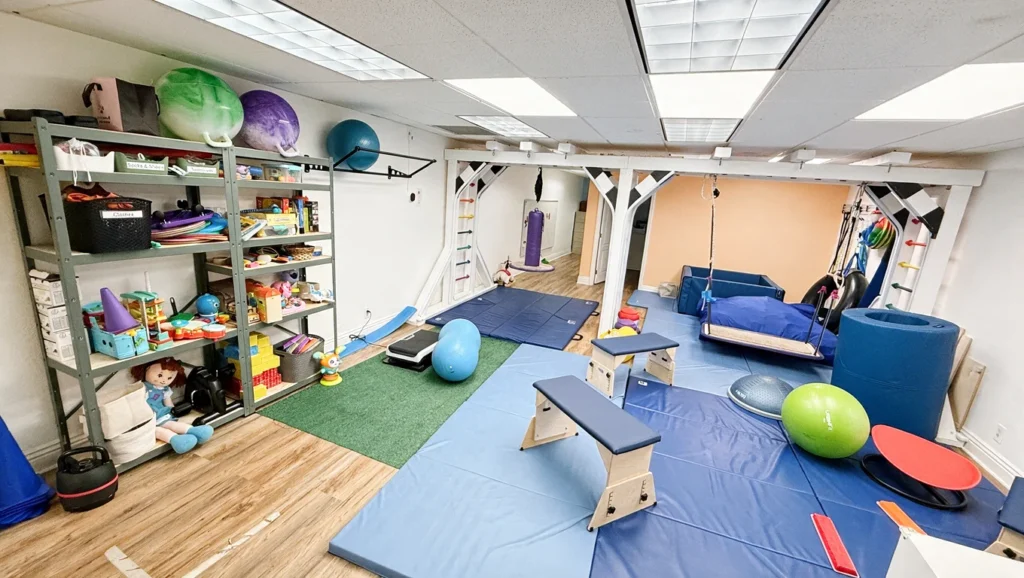
Sensory Bridge’s therapy gym. The home games below use ordinary household items.
Your preschooler wants to move, but a park trip does not fit the afternoon. You do not need to build a climbing course in the living room. A clear patch of floor, a few familiar objects and your attention can be enough to begin.
For children ages 3–5, the CDC recommends physical activity throughout the day. That leaves room for different kinds of active play across ordinary routines. One short game does not need to meet the whole day’s activity needs, and it does not have to become an exercise lesson.
First, make the space work
Choose a level, non-slip surface away from stairs, sharp furniture and breakable objects. Clear loose toys from the path and stay nearby. Keep movement at floor level rather than asking your child to climb furniture. Offer a pause whenever needed. If your child has a movement plan or equipment needs, use their care team’s guidance.
These are illustrative play ideas. Choose movements your child already manages comfortably, and let them help shape the game.
1. Copy one dance move
Invite your child to invent a small movement, such as waving both arms, swaying or marching in place. Copy it, then offer a turn of your own. Music is optional; your voice or a steady clap may be enough.
Illustrative example: “You picked a shoulder wiggle. I’ll copy you. What should we try next?” Seated arm movements are another way to join. Skip moves that cause discomfort rather than insisting on a particular position.
The American Academy of Pediatrics includes dancing among its playful ways to get children moving.
2. Make a toy delivery
Place two large, familiar toys at an easy-to-reach height. Ask your child to deliver one to an empty basket a few steps away. Keep the route clear and walk together. Your child can choose which toy travels first.
Illustrative example: Draw a bear and a car on separate pieces of paper. Hold up one picture as a delivery clue. If carrying an object makes walking harder, you can carry it while your child chooses the destination or moves alongside you.
Shared attention and exploring familiar objects are part of the AAP’s indoor family play ideas. Keep this a shared game rather than a speed test.
3. Roll toward a target
Sit facing each other and gently roll a large, soft ball back and forth. A loosely rolled pair of adult socks can be an alternative if your child does not mouth objects. Start close together. An empty basket on its side can become a target, but simply returning the ball counts as play.
Let your child choose another turn or a different activity. Short, enjoyable opportunities are useful even when the game looks different from what you planned.
Optional tools for trying this at home
Here are a few optional tools for trying these activities at home. You can also use what you already have. If you purchase through these links, Sensory Bridge may receive a small commission at no additional cost to you. As an Amazon Associate I earn from qualifying purchases.
- Crayola Ultra-Clean Washable Broad Line Markers, 10 count, on Amazon: An adult can draw the toy-delivery picture clues. Keep markers and caps out of children’s reach while preparing the cards.
Use what you have: Pencil drawings, existing photos or simply naming the toy work, too.
If movement regularly feels uncomfortable or keeps your child from joining play, discuss it with their pediatrician. To talk about everyday movement and getting started with Sensory Bridge Pediatric Therapy, call (909) 258-9292.